Hey there! I’m a supplier of ball bearing disc springs, and today I’m gonna talk about how to calculate the energy storage capacity of a ball bearing disc spring. This is something that’s super important for anyone who uses these springs, whether you’re in the automotive industry, machinery manufacturing, or any other field that relies on these nifty little components. Ball Bearing Disc Spring
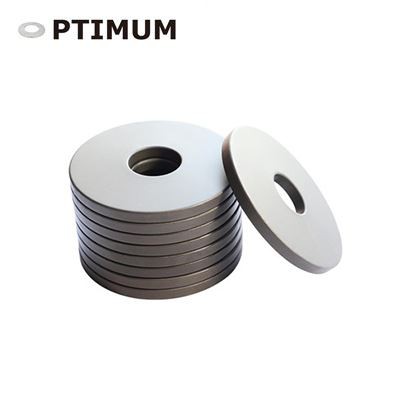
First off, let’s understand what energy storage capacity means. In simple terms, it’s the amount of energy a spring can hold when it’s compressed. This energy can then be released when the spring returns to its original shape. For ball bearing disc springs, this capacity is crucial because it determines how well the spring can perform its job, like absorbing shocks, providing a constant force, or maintaining a specific pressure.
Now, let’s get into the nitty – gritty of calculating the energy storage capacity. There are a few key factors we need to consider: the material of the spring, its dimensions, and the amount of compression.
Material of the Spring
The material of the ball bearing disc spring plays a huge role in its energy storage capacity. Different materials have different elastic properties. For example, high – strength steel is a popular choice because it can withstand a lot of stress and has a high modulus of elasticity. The modulus of elasticity, often denoted as E, is a measure of how much a material can deform under stress and still return to its original shape. A higher modulus means the spring can store more energy.
Let’s say we have a spring made of a high – strength steel with a modulus of elasticity of around 200 GPa (gigapascals). This high value indicates that the spring can handle a significant amount of force before it starts to deform permanently. On the other hand, if we use a material with a lower modulus, like some types of aluminum, the spring won’t be able to store as much energy.
Dimensions of the Spring
The dimensions of the ball bearing disc spring are also super important. We’re mainly talking about the outer diameter (D), the inner diameter (d), and the thickness (t) of the spring.
The outer and inner diameters affect the spring’s stiffness. A larger outer diameter generally means a stiffer spring, which can store more energy. The thickness of the spring also has a big impact. A thicker spring can withstand more force and thus store more energy.
The formula for the energy storage capacity (U) of a disc spring is based on the work done in compressing the spring. The basic formula for the energy stored in a spring is (U=\frac{1}{2}F\delta), where F is the force applied to the spring and (\delta) is the deflection (the amount the spring is compressed).
However, for a disc spring, we need to use a more complex formula that takes into account the dimensions and material properties. The formula for the energy stored in a disc spring is:
(U = \frac{1 – \nu^{2}}{E}\times\frac{1}{8}\times\frac{h_{0}^{2}-t^{2}}{t}\times F)
where (\nu) is Poisson’s ratio (a property of the material, usually around 0.3 for steel), (h_{0}) is the initial height of the spring, and t is the thickness of the spring.
Let’s break this down a bit. The term (\frac{1 – \nu^{2}}{E}) is related to the material properties. As we mentioned earlier, a higher E (modulus of elasticity) and a lower (\nu) (Poisson’s ratio) will result in a higher energy storage capacity.
The term (\frac{h_{0}^{2}-t^{2}}{t}) is related to the geometry of the spring. A larger (h_{0}) (initial height) relative to the thickness t will increase the energy storage capacity.
Amount of Compression
The amount of compression, or deflection, of the spring is another crucial factor. The more you compress the spring, the more energy it stores. But there’s a limit to how much you can compress a spring without causing permanent deformation.
Let’s say we have a ball bearing disc spring with a certain set of dimensions and material properties. If we compress it by a small amount, the energy stored will be relatively low. But if we compress it to its maximum allowable deflection, the energy storage capacity will be at its peak.
To calculate the energy storage capacity based on the deflection, we can use the formula:
(U=\int_{0}^{\delta}F(x)dx)
where (\delta) is the deflection and (F(x)) is the force as a function of the deflection. In practice, for a disc spring, we can approximate this integral using numerical methods or by using simplified formulas based on the spring’s characteristics.
Real – World Example
Let’s say we have a ball bearing disc spring made of high – strength steel with an outer diameter (D = 50) mm, an inner diameter (d = 25) mm, a thickness (t = 5) mm, and an initial height (h_{0}= 7) mm. The modulus of elasticity (E = 200) GPa and Poisson’s ratio (\nu=0.3).
First, we need to calculate the spring constant (k). The formula for the spring constant of a disc spring is:
(k=\frac{E\times t^{3}}{4\times(1 – \nu^{2})\times D^{2}\times(1-\frac{d}{D})^{2}})
Plugging in the values, we get:
(k=\frac{200\times10^{9}\times(0.005)^{3}}{4\times(1 – 0.3^{2})\times(0.05)^{2}\times(1-\frac{0.025}{0.05})^{2}})
After calculating, we find the spring constant (k). Then, if we know the deflection (\delta), we can calculate the force (F = k\delta).
Let’s say the spring is compressed by (\delta = 2) mm. We can calculate the energy stored using (U=\frac{1}{2}F\delta).
(F = k\times0.002)
(U=\frac{1}{2}\times F\times0.002)
Importance of Accurate Calculation
Accurately calculating the energy storage capacity of a ball bearing disc spring is super important. If you overestimate the capacity, the spring might not be able to handle the load, leading to premature failure. On the other hand, if you underestimate it, you might end up using a spring that’s larger and more expensive than necessary.
In industries like automotive and aerospace, where safety is a top priority, accurate calculations are essential. A faulty spring can lead to serious accidents, so getting it right is crucial.
Conclusion
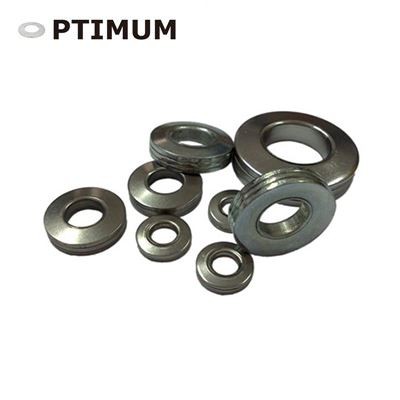
So, there you have it! Calculating the energy storage capacity of a ball bearing disc spring involves considering the material, dimensions, and amount of compression. By using the right formulas and understanding the properties of the spring, you can ensure that you’re using the right spring for your application.
Serrated Safety Washer If you’re in the market for ball bearing disc springs and need help with calculating the energy storage capacity or just want to learn more about our products, don’t hesitate to reach out. We’re here to help you find the perfect spring for your needs. Whether you’re a small – scale manufacturer or a large – scale industrial company, we’ve got the expertise and the products to meet your requirements. So, get in touch and let’s start a conversation about your spring needs!
References
- Shigley, J. E., & Mischke, C. R. (2001). Mechanical Engineering Design. McGraw – Hill.
- Budynas, R. G., & Nisbett, J. K. (2011). Shigley’s Mechanical Engineering Design. McGraw – Hill.
Yangzhou Optimum Spring Manufacturing Co., Ltd.
As one of the most professional ball bearing disc spring manufacturers and suppliers in China, we’re featured by quality products and good service. Please rest assured to buy customized ball bearing disc spring made in China here from our factory. For more information, contact us now.
Address: No.9 West of Shuangtang Rd, Yangzhou, P.R. China 225000
E-mail: susie@optimum-spring.com
WebSite: https://www.optimum-spring.com/
